Smart Watch Cameras vs. Body Cameras: Pros and Cons
· @Joe Kosoglow
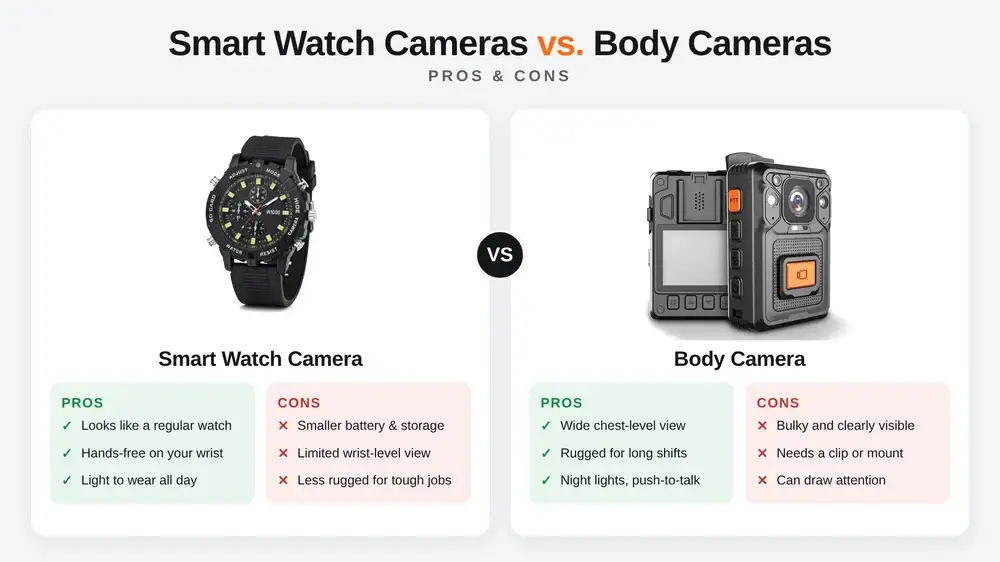
A body camera is the right choice when you need to record a full shift, openly, with footage that will hold up as evidence. A smart watch camera is a better fit when you need to record without being noticed, usually for short periods. Many investigators and security professionals carry both: the body camera as the primary record, and the watch as a discreet backup.
Here’s how the two compare, and the pros and cons of each.
At a glance
The biggest differences are recording time and visibility. The figures below come from cameras Force Pro USA currently sells.
Body camera
Smart watch camera
Recording time
Up to 20 hours of battery life
About 90 to 120 minutes per charge
Visibility
Worn openly on the chest
Looks like an ordinary wristwatch
Video quality
HD, with wide-angle lenses up to 145°
1080p HD; some models record in 2K
Night recording
Night vision on professional models
Infrared night vision on some models
Evidence protection
AES-256 encryption, GPS, and event locking on models like the X7b
Files saved to a microSD card with no encryption
Camera angle
Fixed on the chest, facing what you face
Points wherever your wrist points
Storage
32GB to 128GB built in
16GB to 32GB microSD card
Best for
Patrol, security shifts, and recorded public contact
Undercover work, investigations, and discreet backup
Body cameras: pros and cons
Body cameras are built to record an entire shift and protect the footage as evidence.
Pros
Full-shift battery. Professional models run up to 20 hours, so one camera covers a long shift.
Footage that holds up. Encryption, GPS tags, and date and time stamps help show the video hasn’t been altered.
Hands-free and steady. Mounted on the chest, the camera faces what the officer faces, and stabilization keeps footage usable.
Visible recording changes behavior. A camera people can see can calm tense situations and discourage false complaints.
Grant-eligible. Federal and state programs fund body cameras for public agencies. See our grant funding guide.
Works with evidence software. Footage can be organized and shared through a digital evidence manager.
Cons
Easy to spot. That’s a drawback for undercover or covert work.
More to manage. Larger files, charging, and storage need a plan and a written policy.
Higher price. Professional models typically cost more than a watch camera.
Fixed view. The camera only sees what’s in front of the wearer’s chest.
Smart watch cameras: pros and cons
Watch cameras trade recording time and evidence features for one big advantage: nobody knows they’re there.
Pros
Discreet. It looks like an ordinary watch, so people act naturally.
Always on you. There’s nothing to clip on or forget in the car.
Quick to start. One button press starts recording.
Lower cost. A watch camera usually costs less than a professional body camera.
Useful extras. Some models add motion-activated recording, infrared night vision, and 5MP photos.
Simple file transfer. Plug it into a computer’s USB port to copy the video.
Cons
Short recording time. About 90 to 120 minutes per charge, not a full shift.
Shaky, unpredictable angle. The camera points wherever your wrist goes, so you may miss the key moment.
Weaker evidence protection. No encryption or GPS tagging, so you’ll need your own process to document how footage was handled.
Less storage. A 16GB or 32GB card fills faster than a body camera’s built-in memory.
Recording laws matter more. Covert audio recording is regulated by state law (see below).
Which one fits your job?
The right choice depends on whether you need to be seen recording, and for how long.
Your role
Best choice
Why
Patrol officer
Body camera
Records the full shift, and many departments require visible recording
Security guard or loss prevention
Body camera
Visible recording deters problems and documents incidents
Detective or undercover officer
Smart watch camera
Records without revealing the officer’s role
Private investigator
Smart watch camera, with a body camera when appropriate
Discreet for short meetings; a body camera for longer, open assignments
Process server or field inspector
Either
A watch for brief, low-key visits; a body camera for confrontational ones
Anyone who wants a backup
Both
The watch keeps recording if the body camera is blocked, knocked off, or out of battery
A note on recording laws
Before you record anyone covertly, know your state’s audio recording law. Texas is a one-party consent state: you can record a conversation you’re part of without telling the others. About a dozen states, including California, Florida, Illinois, and Washington, generally require everyone in the conversation to consent. Recording a conversation you aren’t part of is generally illegal in any state.
Officers should also follow their agency’s policy, and any warrant requirements, for covert recording. This is general information, not legal advice. When in doubt, check with your agency’s legal advisor or an attorney.
Not sure which one you need?
Force Pro USA carries both professional body cameras and smart watch cameras. Tell us how you work and we’ll help you choose, whether that’s one camera or a full department order.
Call (214) 288-0240 or email sales@forceprousa.com. Body cameras come with our 1-year replacement guarantee, and orders over $300 ship free.
OVERVIEW Body Worn Camera Welcome Message – Video Resources for Agencies & Security Professionals Practical guides on choosing body-worn cameras, funding them through grants, and managing digital evidence. Written by
Want to keep an eye on your pets, a new caregiver, or your business after hours? These are the hidden cameras we recommend most. Best Force Pro USA hidden cameras
Professional Security Technology. Practical Guidance. Solutions Built Around the Mission. Police departments, private security companies, investigators, and businesses cannot afford to treat security equipment as an ordinary purchase. The cameras,
Introduction Police body-worn cameras (BWCs) have become an essential tool for modern law enforcement agencies. They improve transparency, provide critical evidence, enhance officer accountability, and strengthen community trust. However, purchasing